
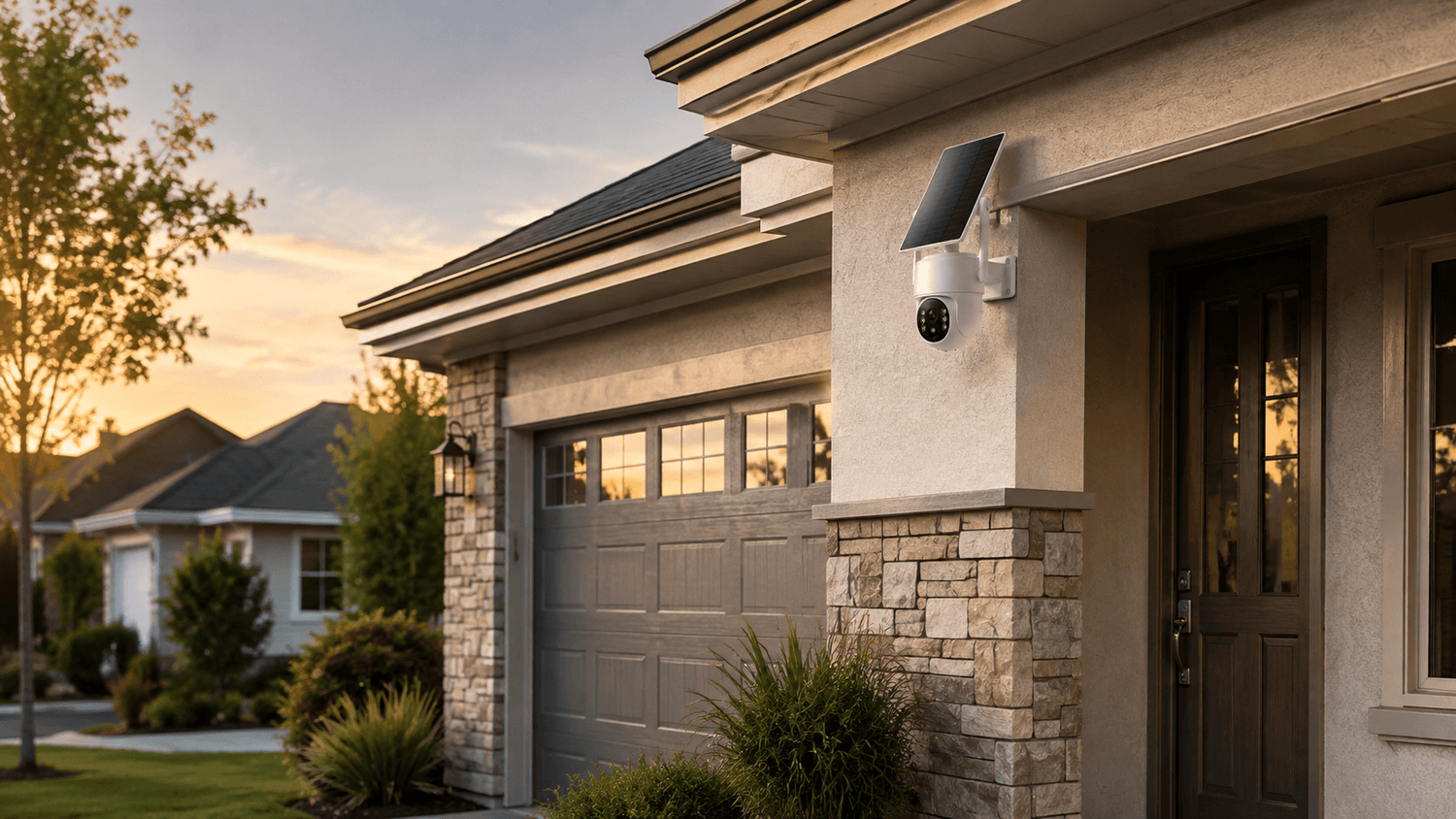
Choosing the right outdoor security camera often comes down to one important question: should you choose a solar security camera or a battery security camera?
Both options can provide wireless installation without the need to run traditional power cables through your walls. However, the way they are powered can make a significant difference in maintenance, installation flexibility, long-term convenience, and where you can install them.
A solar powered security camera uses a solar panel to recharge its built-in battery, while a battery powered security camera relies entirely on a rechargeable or replaceable battery. This means solar cameras can reduce the need for manual charging, while battery cameras generally offer greater flexibility when choosing an installation location.
So, which one is better?
Choose a solar security camera if you want long-term outdoor monitoring with less manual charging and your installation location receives enough sunlight. Choose a battery security camera if maximum placement flexibility is more important and you don't mind periodically recharging or replacing the battery.
Let's compare the two in detail.
Solar Security Camera vs Battery Security Camera: Quick Comparison
| Feature | Solar Security Camera | Battery Security Camera |
|---|---|---|
| Power source | Solar panel + rechargeable battery | Rechargeable or replaceable battery |
| Installation | Wireless with solar panel placement | Very flexible |
| Maintenance | Low | Medium |
| Charging | Solar-assisted | Manual charging required |
| Placement flexibility | High, but needs sunlight | Very high |
| Best for | Long-term outdoor monitoring | Temporary or flexible installations |
| Remote locations | Excellent with suitable connectivity | Good |
| Shaded locations | Less suitable | Better |
| Long-term convenience | Excellent | Depends on battery life |
| Upfront cost | Usually higher | Usually lower |

What Is a Solar Security Camera?
A solar security camera is a wireless outdoor surveillance camera that uses solar energy to recharge its internal battery.
During daylight hours, the solar panel converts sunlight into electrical energy. That energy is stored in the rechargeable battery, allowing the camera to continue operating when sunlight is unavailable, including at night.
Modern solar security cameras can combine several technologies in one system, including:
- HD, 2K, or 4K video
- Motion detection
- Night vision
- AI detection
- Two-way audio
- Wireless connectivity
- Mobile app monitoring
- Local storage
- Solar charging
This makes a solar powered security camera particularly useful for locations where running a power cable would be difficult or expensive.
For example, solar cameras can be installed around driveways, backyards, garages, farms, gates, barns, storage areas, and other outdoor locations.

What Is a Battery Security Camera?
A battery security camera operates using a rechargeable or replaceable battery rather than a solar panel or permanent electrical connection.
Its biggest advantage is simple: you can install the camera in almost any location where the camera can be securely mounted.
Because it doesn't require direct sunlight, a battery camera can work well in areas such as:
- Covered porches
- Shaded entrances
- Garages
- Under eaves
- Indoor spaces
- Temporary construction areas
- Locations surrounded by trees
The trade-off is maintenance.
Once the battery becomes low, someone needs to recharge or replace it. How often this happens depends on factors such as motion activity, recording settings, video quality, weather, temperature, and how frequently the camera is accessed.
Pros of Solar Security Cameras
1. Less Manual Charging
The biggest advantage of a solar powered security camera is reduced charging maintenance.
Instead of regularly removing the camera to recharge its battery, the solar panel can continuously replenish the battery when adequate sunlight is available.
This can be especially valuable when cameras are installed in hard-to-reach locations.
Imagine having security cameras installed around a large backyard, driveway, farm, or detached garage. Manually checking several battery cameras can quickly become inconvenient.
Solar charging can reduce the amount of maintenance required.

2. Excellent for Long-Term Outdoor Monitoring
Solar security cameras are particularly attractive for users who want to install a camera and leave it in place for an extended period.
Once properly installed, the camera can use solar energy to help maintain its battery.
This makes solar surveillance cameras a strong choice for:
- Large residential properties
- Farms and rural properties
- Driveways
- Gardens
- Gates
- Barns
- Garages
- Vacation homes
- Outdoor storage areas
3. No Permanent Power Wiring
A solar security camera doesn't need a traditional AC power cable running to the camera.
That can make installation much easier when an electrical outlet isn't nearby.
For properties where running power cables would require drilling, trenching, or professional electrical work, a wireless solar camera can be a much more convenient solution.
4. Great for Remote Locations
Solar power becomes especially useful when the camera is located far away from the house.
For example, a property owner may want to monitor a farm entrance, detached barn, driveway gate, or outdoor storage area where household electricity isn't easily available.
As long as the solar panel receives adequate sunlight and the camera has a suitable network connection, solar-powered surveillance can provide a practical alternative to traditional wired security cameras.
Cons of Solar Security Cameras
1. Solar Panels Need Sunlight
The biggest limitation of a solar security camera is also its biggest advantage: solar power depends on sunlight.
A solar panel performs best when it receives sufficient sunlight.
If the camera is installed underneath heavy tree cover, behind a building, or in a location with very limited direct sunlight, solar charging may be reduced.
That doesn't mean solar cameras cannot be used in cloudy areas. However, installation location becomes more important.
2. Installation Requires More Planning
With a battery camera, you mainly need to decide where to mount the camera.
With a solar camera, you need to consider both the camera's viewing angle and the solar panel's exposure to sunlight.
The best security camera location is therefore not always the best solar panel location.
Before installation, consider:
- Sun exposure
- Camera viewing angle
- WiFi signal
- Motion detection area
- Solar panel angle
- Cable routing between the panel and camera
3. Higher Initial Investment
Solar security cameras may cost more upfront because the system includes a solar panel and rechargeable battery.
However, the higher initial cost can be worthwhile for users who prioritize lower maintenance and long-term outdoor monitoring.
Pros of Battery Security Cameras
1. Maximum Installation Flexibility
A battery powered security camera doesn't need sunlight.
This gives you much more freedom when choosing where to install it.
You can mount a battery camera on a shaded wall, under a roof, inside a garage, or in another location where solar charging would be difficult.
This makes battery security cameras especially useful when the installation location changes frequently.
2. Simple Installation
Battery cameras are usually straightforward to install.
Mount the camera, connect it to the appropriate app or network, and you're ready to begin monitoring.
There is no solar panel that needs to be positioned and no permanent power cable that needs to be installed.
For renters and homeowners looking for a simple DIY security camera installation, this can be a major advantage.
3. Works in Shaded Locations
Not every outdoor area receives enough sunlight.
A camera underneath a covered porch or surrounded by tall trees may not be an ideal location for solar charging.
In these situations, a battery-powered outdoor security camera can be the better option.
Cons of Battery Security Cameras
1. Regular Charging Is Required
The main disadvantage of a battery security camera is that the battery eventually runs out.
Once the battery reaches a low level, you need to recharge it or replace it.
The frequency depends heavily on usage.
A camera watching a quiet backyard may consume much less power than a camera monitoring a busy driveway where motion events occur constantly.
2. More Maintenance Over Time
If you have one battery camera, recharging it may not be a big deal.
But consider a property with four, six, or eight wireless security cameras.
Managing multiple batteries can become a regular maintenance task.
This is one reason solar powered security camera systems can be attractive for larger properties and long-term installations.
3. Battery Performance Can Change With Conditions
Battery performance can be affected by factors such as temperature and usage.
Cold weather can be particularly challenging for rechargeable batteries, while frequent motion detection can increase power consumption.
For locations with heavy activity, users should pay close attention to battery capacity and power management features when choosing a wireless security camera.
Solar Security Camera vs Battery Security Camera: Which Is Better?
There is no universal winner.
The best choice depends on your property and how you plan to use the camera.
Choose a Solar Security Camera If:
- You want long-term outdoor monitoring
- You want less manual charging
- The camera location receives good sunlight
- You are monitoring a large property
- The camera is difficult to access
- You want a low-maintenance security solution
- You need surveillance in an area without a convenient power outlet
Choose a Battery Security Camera If:
- You need maximum placement flexibility
- The installation area is shaded
- You frequently move your camera
- You need a temporary security solution
- You are monitoring a porch, garage, or covered area
- You don't mind periodically recharging the battery
What About a Solar + Battery Security Camera?
Here's an important point that many buyers overlook.
A solar security camera is usually not simply a camera that runs directly from sunlight.
Instead, the solar panel helps recharge a battery, and the battery provides stored energy when sunlight isn't available.
This combination is one of the reasons modern solar security cameras can be practical for outdoor surveillance.
During the day, solar energy helps replenish the battery. At night, the stored energy powers the camera.
This makes the solar panel + rechargeable battery combination particularly useful for long-term outdoor monitoring.
Is a Solar Security Camera Worth It?
For many homeowners, yes.
A solar security camera can be a smart investment if your installation location has adequate sunlight and you want to reduce the need for manual charging.
It is especially useful for outdoor areas where running power cables is difficult.
However, solar isn't automatically better for every situation.
If your camera must be installed in a heavily shaded location, a battery security camera may be more practical.
The best security camera is the one that matches your environment.
Why Camcamp Solar Security Cameras Are a Practical Choice

Camcamp focuses on wireless security solutions designed for outdoor monitoring, including solar-powered security camera systems.
For homeowners who want broader property coverage, a system such as the Camcamp SC43 combines wireless outdoor cameras with a dedicated NVR monitor and local storage, making it suitable for monitoring areas such as homes, driveways, yards, garages, and larger properties.
A solar-powered security camera system can be particularly useful when you want to reduce the need for individual battery charging while maintaining flexible outdoor installation.
For homeowners comparing solar security cameras vs battery security cameras, the key question is not simply which technology is newer.
The better question is:
Where will you install the camera, how often can you access it, and how much maintenance are you willing to perform?
Final Verdict: Solar or Battery Security Camera?
Both solar and battery-powered security cameras have clear advantages.
Solar security cameras are best for long-term, low-maintenance outdoor surveillance where sufficient sunlight is available.
Battery security cameras are best when installation flexibility is the priority, especially in shaded or temporary locations.
If you're protecting a large property, driveway, farm, backyard, gate, or detached building, a solar-powered security camera can reduce maintenance and make wireless installation much easier.
If you're protecting a covered porch, shaded entrance, garage, or temporary location, a battery security camera may be the simpler solution.
For many homeowners, the decision ultimately comes down to one thing:
Sunlight or flexibility?
If you have sunlight, a solar security camera can help keep your camera powered with less manual maintenance. If you don't, a battery-powered security camera gives you the freedom to install the camera where you need it most.
FAQ
Are solar security cameras better than battery security cameras?
Solar security cameras are generally better for long-term outdoor monitoring when the installation location receives adequate sunlight. Battery security cameras are better when maximum placement flexibility is more important.
Do solar security cameras still work at night?
Yes. Solar security cameras use stored energy in their rechargeable batteries to operate when sunlight is unavailable, including at night.
Do solar security cameras work on cloudy days?
They can still operate, but charging performance depends on available sunlight, solar panel efficiency, battery capacity, and overall power consumption.
What is the best security camera for a large property?
For large properties, a solar-powered wireless security camera system can be a practical choice because it reduces the need for frequent manual charging and avoids running power cables to every camera.
Are battery security cameras good for outdoor use?
Yes. Battery-powered outdoor security cameras can be very useful for entrances, garages, porches, shaded areas, and locations where solar charging isn't practical.
Can a solar security camera replace a wired security camera?
For some outdoor monitoring applications, yes. Solar cameras offer wireless installation and battery-backed operation. However, wired systems can still be preferable when continuous power and continuous recording are the highest priorities.
What should I consider before buying a solar security camera?
Consider sunlight exposure, battery capacity, video resolution, night vision, motion detection, storage, connectivity, weather resistance, viewing angle, and installation location.

Leave a comment
This site is protected by hCaptcha and the hCaptcha Privacy Policy and Terms of Service apply.