
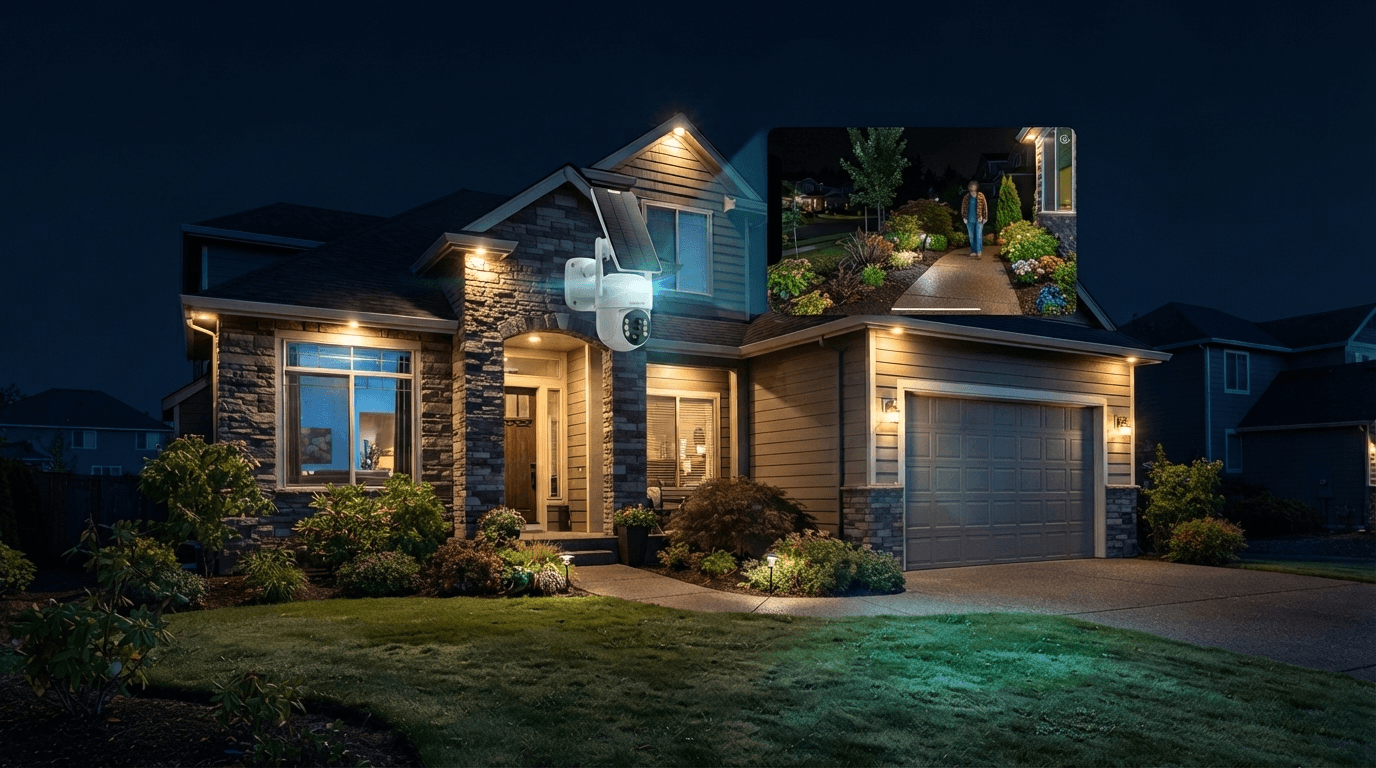
When shopping for a security camera, one of the biggest decisions you'll face is choosing between color night vision and infrared (IR) night vision. Both technologies are designed to protect your property after dark, but they perform very differently depending on lighting conditions, installation environment, and your security goals.
Many homeowners assume that color night vision is always better because it produces vivid images. Others prefer infrared because it delivers reliable monitoring even in complete darkness.
So which technology actually offers the best protection?
In this guide, we'll compare color night vision vs infrared night vision, explain how each works, discuss their advantages and disadvantages, and help you determine which type of wireless security camera is right for your needs.
What Is Color Night Vision?
Color night vision allows a camera to capture full-color images and videos at night instead of traditional black-and-white footage.
Modern color night vision cameras achieve this through several technologies:
- Large image sensors
- Wide aperture lenses
- AI image enhancement
- High-sensitivity CMOS sensors
- Built-in warm LED spotlights
Instead of relying solely on infrared light, these cameras collect more ambient light from nearby sources such as:
- Street lights
- Porch lights
- Garden lighting
- Moonlight
Some models automatically activate white LEDs when motion is detected, illuminating the scene while recording in full color.
The biggest advantage is obvious:
You can identify clothing colors, vehicle colors, packages, and other important details that black-and-white footage may miss.
How Infrared Night Vision Works
Infrared night vision uses IR LEDs positioned around the camera lens.
These LEDs emit invisible infrared light that reflects off nearby objects. Although humans cannot see infrared light, the camera sensor can.
The result is:
- Black-and-white video
- Clear images even in total darkness
- No visible light emitted
Infrared technology has been trusted in security cameras for decades because it offers dependable performance without attracting attention.
It is particularly useful for:
- Rural homes
- Farms
- Warehouses
- Garages
- Remote cabins
- Wildlife monitoring
Color Night Vision Advantages
1. Better Identification
Color footage helps identify:
- Vehicle colors
- Clothing
- Hair color
- Packages
- Pets
- Property damage
These details can become important evidence after an incident.
2. Improved AI Recognition
Modern AI security cameras analyze:
- Human movement
- Vehicles
- Pets
- Packages
Having color information often improves object classification and reduces false alerts.
3. Easier to Review Footage
Color video feels much more natural.
Users can quickly understand what happened without interpreting grayscale images.
4. Better Evidence
Police and insurance companies often benefit from color evidence because it includes additional identifying information.

Infrared Night Vision Advantages
1. Works in Complete Darkness
Unlike color night vision, infrared cameras require no ambient light.
Even if every nearby light is turned off, IR cameras continue recording.
2. Longer Night Vision Distance
Many infrared cameras provide excellent viewing distances.
Depending on the model, IR illumination can reach:
- 30 feet
- 65 feet
- 100 feet
- 130 feet or more
This makes infrared suitable for monitoring larger outdoor spaces.
3. Lower Power Consumption
Without bright white LEDs running continuously, infrared systems generally consume less power.
This makes them ideal for:
- Solar-powered cameras
- Battery-powered cameras
4. More Discreet Monitoring
Infrared LEDs are nearly invisible.
Most people never realize the camera is actively recording.

Color Night Vision vs Infrared Night Vision
| Feature | Color Night Vision | Infrared Night Vision |
|---|---|---|
| Image | Full Color | Black & White |
| Total Darkness | Needs some light or spotlight | Excellent |
| Evidence Quality | Excellent | Very Good |
| Long Distance | Moderate | Better |
| Energy Consumption | Higher | Lower |
| Discreet Recording | Lower | Excellent |
| Human Recognition | Excellent | Good |
| Vehicle Identification | Excellent | Moderate |
Which One Is Better?
The answer depends on your environment.
Choose Color Night Vision if:
- Your home has porch lighting
- You want better evidence
- You need facial recognition
- You receive frequent deliveries
- You want vivid recordings
Choose Infrared Night Vision if:
- Your property is completely dark
- You monitor farms
- You monitor forests
- You need maximum night distance
- You want discreet surveillance
Can You Have Both?
Yes.
Many modern outdoor security cameras automatically switch between infrared and color night vision depending on lighting conditions.
This hybrid approach provides:
- Color when ambient light is available
- Infrared in complete darkness
- Smart switching
- Better overall security
For homeowners who want the best of both worlds, a dual-mode camera is often the ideal choice.

Why Camcamp Cameras Deliver Reliable Night Protection
A quality security camera should perform consistently regardless of lighting conditions.
Camcamp wireless outdoor security cameras are designed to provide dependable monitoring with features such as:
- High-resolution video
- Smart AI motion detection
- Remote viewing through the mobile app
- Weather-resistant construction
- Solar-powered options for continuous operation
- Flexible night vision modes on supported models
Whether you're protecting your home, driveway, backyard, garage, or small business, choosing the right night vision technology helps ensure you never miss important events after sunset.
FAQ
Is color night vision better than infrared?
Not always. Color night vision provides more visual detail, while infrared performs better in complete darkness.
Does color night vision require lights?
Most cameras need either ambient lighting or built-in white LEDs to produce full-color nighttime images.
Which night vision is better for home security?
For most residential areas with porch lights or street lighting, color night vision offers better identification. In very dark environments, infrared remains the more reliable option.
Does infrared light bother people?
No. Infrared LEDs are generally invisible to the human eye and are commonly used for discreet nighttime monitoring.
Which is better for outdoor security?
Many users prefer cameras that support both color and infrared night vision, allowing the system to adapt automatically to changing light conditions.

Final Thoughts
Both color night vision and infrared night vision offer valuable advantages. Color footage excels at identifying people, vehicles, and important details, while infrared technology remains unmatched for reliable monitoring in complete darkness. Rather than viewing one as universally better, the best choice depends on your property's lighting conditions and security priorities.
If you're looking for a modern wireless outdoor security camera that delivers dependable performance day and night, choosing a solution with intelligent night vision modes can provide greater flexibility and peace of mind.


Leave a comment
This site is protected by hCaptcha and the hCaptcha Privacy Policy and Terms of Service apply.