
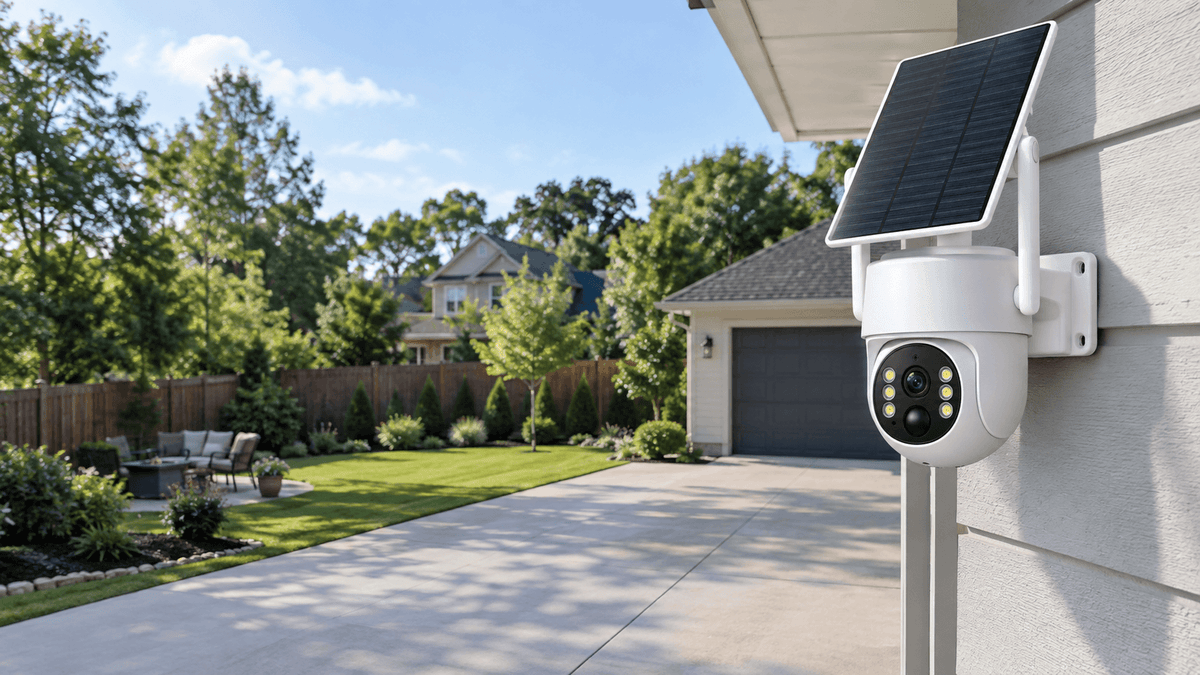
If you are comparing outdoor security cameras, you have probably come across the term PTZ security camera. But what does PTZ actually mean, and why are pan, tilt, and zoom important for home and property security?
PTZ stands for Pan, Tilt, and Zoom. Unlike a fixed security camera that continuously monitors one direction, a PTZ camera can move horizontally, move vertically, and zoom in on specific areas. This gives one camera the ability to cover a much larger area.
Modern PTZ security cameras are commonly used for homes, driveways, yards, farms, businesses, parking areas, warehouses, and other properties that require flexible outdoor surveillance.
In this guide, we will explain how PTZ cameras work, what pan, tilt, and zoom mean, their advantages and limitations, and how to choose the right PTZ security camera for your property.
What Does PTZ Mean?
PTZ stands for three camera functions: Pan, Tilt, and Zoom.
Pan
Pan refers to the camera's ability to rotate horizontally from left to right.
For example, instead of monitoring only the front of your driveway, a PTZ camera can move from the driveway toward the backyard or another area of your property.
This makes a PTZ camera useful when you need to monitor a wide outdoor area.
Tilt
Tilt refers to the camera's ability to move vertically up and down.
A PTZ security camera can adjust its viewing angle to monitor areas closer to the ground or higher areas such as gates, entrances, and second-story locations.
The combination of pan and tilt allows the camera to change its viewing direction without physically moving the camera mount.
Zoom
Zoom allows the camera to get a closer view of a distant object or area.
Depending on the camera design, zoom can be digital or optical. Optical zoom changes the lens magnification while maintaining more image detail, while digital zoom enlarges part of the image electronically.
For outdoor security, zoom can be particularly useful when monitoring driveways, gates, entrances, parking areas, or other locations that are farther away from the camera.

How Does a PTZ Security Camera Work?
A PTZ security camera uses a motorized mechanism to control the camera's viewing direction.
When you control the camera through a mobile app, NVR, or other compatible system, the camera can rotate horizontally, move vertically, or adjust its zoom.
Some modern smart PTZ security cameras can also provide automated monitoring features. Depending on the model, these may include motion detection, preset viewing positions, automatic tracking, human detection, vehicle detection, or AI-powered alerts.
For example, you could create preset positions for:
- Front door
- Driveway
- Backyard
- Side gate
- Garage
- Pool area
Instead of installing a separate fixed camera for every viewing direction, a PTZ camera can move between different areas.

PTZ Security Camera vs. Fixed Security Camera
The biggest difference between a PTZ camera and a traditional fixed security camera is the field of view and movement capability.
A fixed security camera normally points in one direction. It is excellent when you know exactly which area needs continuous monitoring.
A pan tilt zoom camera, on the other hand, can change its viewing direction.
For example, imagine a large backyard with a driveway on one side and a gate on the other.
A fixed camera may only cover one section of the property. A PTZ outdoor security camera can move between the driveway, gate, and backyard when necessary.
However, PTZ does not automatically mean that one camera can replace every fixed camera. If you need simultaneous continuous monitoring of several locations, multiple fixed cameras may still be useful.
The right choice depends on the size and layout of your property.
What Are the Benefits of a PTZ Security Camera?
1. Wider Coverage
One of the biggest advantages of a PTZ camera is its ability to monitor a large area.
Because the camera can pan and tilt, it can look in different directions instead of being permanently fixed toward one area.
This makes PTZ cameras particularly useful for large yards, farms, driveways, commercial properties, and outdoor spaces.
2. Remote Control
Many modern PTZ security cameras can be controlled remotely through a smartphone app.
If you receive a motion alert while you are away from home, you may be able to open the camera and manually change its viewing direction.
You can then check another area of the property without physically being there.
3. Zoom for Distant Areas
The zoom function can help you inspect areas that are farther away from the camera.
For example, you may want to look more closely at a vehicle entering your driveway or a person approaching a gate.
The usefulness of zoom depends heavily on the camera's resolution, lens, and zoom technology.
4. Preset Viewing Positions
Some PTZ cameras support preset positions.
You can save several important viewing angles and quickly move the camera between them.
This is useful for properties with multiple areas that require regular monitoring.
5. Useful for Large Outdoor Areas
A PTZ outdoor security camera can be particularly useful when you need flexible surveillance over a large outdoor area.
Typical applications include:
- Large backyards
- Driveways
- Farms
- Gardens
- Garages
- Warehouses
- Parking lots
- Construction sites
- Commercial properties
Are PTZ Cameras Good for Home Security?
Yes, a PTZ security camera can be a useful option for home security when the property requires flexible coverage.
For example, homeowners with a large yard may want one camera that can monitor different areas instead of pointing permanently in one direction.
A wireless PTZ security camera can also simplify installation in locations where running long cables is difficult.
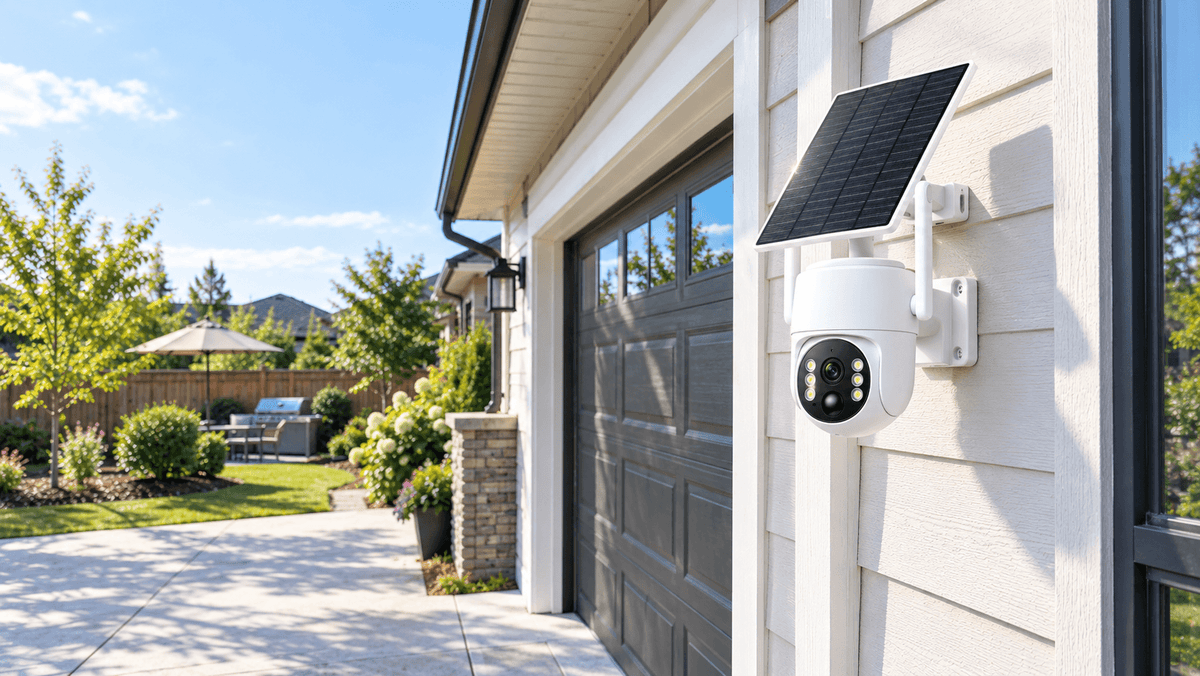
For locations without convenient access to electrical power, a solar PTZ security camera may provide another installation option.
However, homeowners should consider the camera's power source, network connection, storage method, weather resistance, viewing range, and night vision performance before purchasing.
PTZ Security Camera for Outdoor Use
When choosing an outdoor PTZ security camera, weather resistance is an important consideration.
Outdoor cameras may be exposed to:
- Rain
- Dust
- Sunlight
- Humidity
- Wind
- Temperature changes
Look for a camera designed specifically for outdoor installation and check its published weather-resistance rating.
Night vision is another important feature.
If your property needs 24-hour surveillance, consider the camera's infrared night vision performance, low-light image quality, and effective detection range.
A camera that produces excellent daytime video may perform differently in complete darkness.
What Is a Solar PTZ Security Camera?
A solar PTZ security camera combines PTZ movement with solar-powered operation.
Instead of relying entirely on a traditional electrical connection, the camera can use a solar panel to recharge its battery.
This can be especially useful for outdoor locations where running power cables is difficult, such as farms, large yards, remote gates, gardens, and other areas away from the main building.
Solar PTZ cameras are generally designed to operate efficiently by using power when needed for functions such as motion detection, recording, alerts, and remote access.
Actual battery life and performance depend on factors such as sunlight, weather, temperature, recording frequency, network connection, and camera settings.

Does a PTZ Camera Provide 360-Degree Coverage?
Not necessarily.
Some PTZ cameras can rotate horizontally through a very wide range, and certain models can provide nearly 360-degree horizontal coverage.
However, the exact viewing range depends on the camera's mechanical design.
It is important to distinguish between 360-degree rotation and simultaneous 360-degree monitoring.
A PTZ camera moves to look at different directions. It does not necessarily record every direction at the exact same moment.
If continuous simultaneous coverage of multiple directions is required, a multi-camera system or a camera specifically designed for panoramic coverage may be more appropriate.
PTZ Camera with AI Motion Detection
Many newer smart security cameras combine PTZ movement with AI-based detection technology.
Depending on the model, AI features may help distinguish between different types of motion, such as people, vehicles, or general movement.
Some cameras can also automatically track a detected subject.
This can make PTZ cameras more useful for active outdoor monitoring because the camera may be able to change its viewing direction when relevant motion is detected.
However, AI detection performance can vary depending on lighting, distance, weather, camera placement, and the specific technology used by the manufacturer.

How to Choose the Right PTZ Security Camera
Before buying a PTZ camera, consider these factors:
Pan and Tilt Range
Check how far the camera can rotate horizontally and vertically.
A wider movement range can provide greater flexibility for large properties.
Resolution
Higher resolution can provide more image detail, especially when viewing distant objects.
For outdoor surveillance, 2K, 4MP, 4K, and other high-resolution cameras are common options.
Zoom
Check whether the camera uses digital zoom or optical zoom.
If identifying distant details is important, pay close attention to the actual lens specifications rather than looking only at the advertised zoom number.
Night Vision
Look at the camera's infrared range and low-light performance.
A good outdoor security camera should provide useful nighttime images in the conditions where it will actually be installed.
Connectivity
PTZ cameras may use Wi-Fi, Ethernet, cellular connectivity, or other connection methods.
Choose the connection type based on where you plan to install the camera.
Power Source
You can find wired, battery-powered, and solar-powered PTZ security cameras.
For locations without convenient electrical access, a solar or battery-powered design can simplify installation.
Storage
Check whether the camera supports cloud storage, local storage, microSD cards, NVR recording, or a combination of storage options.
Is a PTZ Security Camera Worth It?
A PTZ security camera can be useful when you need flexible surveillance over a large area.
Its ability to pan, tilt, and zoom gives you more control than a traditional fixed security camera.
For smaller areas where one specific viewing angle is all you need, a fixed camera may be sufficient. For larger properties with multiple areas of interest, a PTZ camera can provide more flexibility.
The key is to match the camera's movement range, resolution, night vision, connectivity, power source, and storage options to your actual security needs.
For homeowners looking for flexible outdoor monitoring, a PTZ security camera system can be an effective part of a broader home security setup.
Final Thoughts
So, what is a PTZ security camera?
Simply put, it is a security camera that can Pan, Tilt, and Zoom.
Pan lets the camera move horizontally. Tilt lets it move vertically. Zoom lets you get a closer view of distant areas.
Together, these functions make PTZ cameras particularly useful for large outdoor spaces, driveways, farms, gardens, entrances, and commercial properties.
When choosing a PTZ camera, don't focus only on the movement range. Consider resolution, night vision, zoom technology, AI detection, connectivity, storage, weather resistance, and power requirements as well.
With the right combination of features, a modern PTZ security camera can provide flexible and convenient surveillance for both residential and commercial environments.

Leave a comment
This site is protected by hCaptcha and the hCaptcha Privacy Policy and Terms of Service apply.