
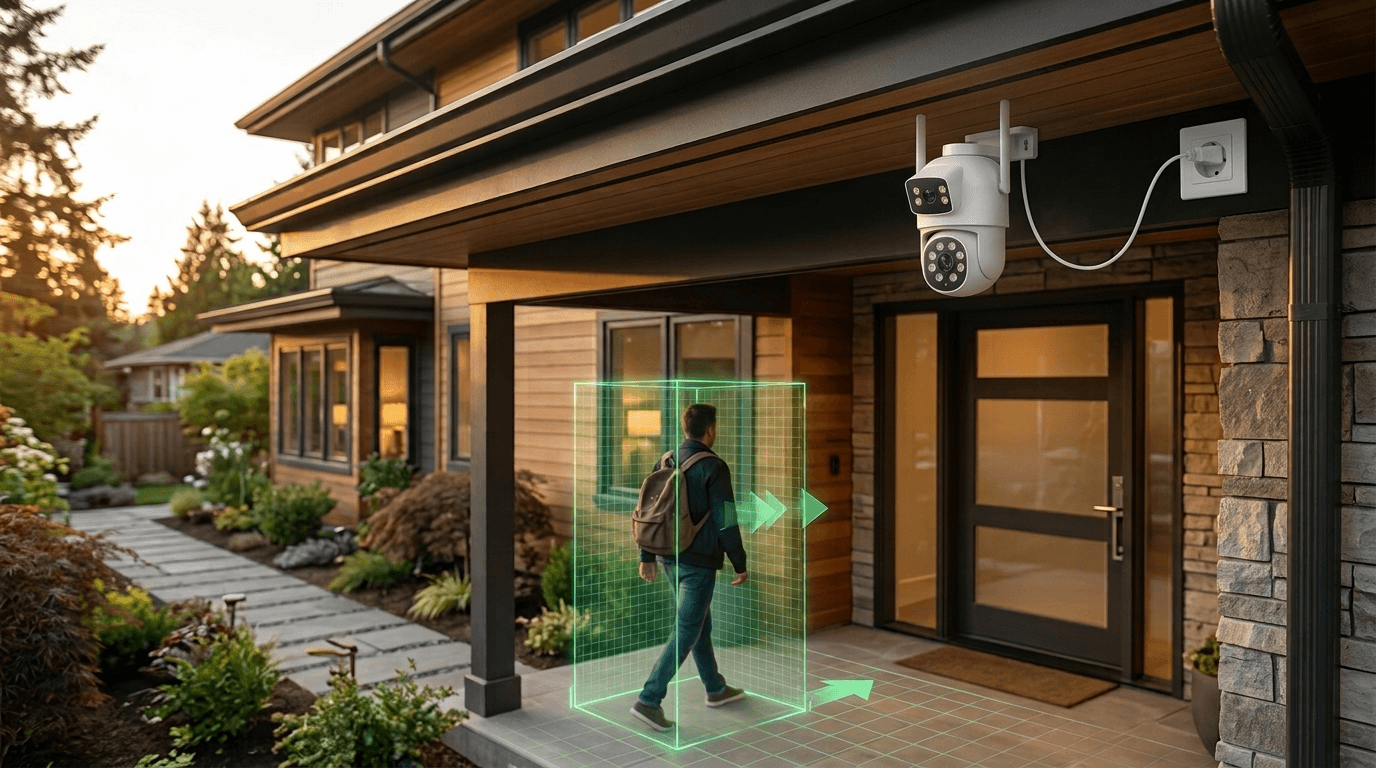
Motion detection has become one of the most important features in modern security cameras. Instead of recording every second of the day, today's smart security cameras intelligently recognize movement, notify homeowners instantly, and capture important events while minimizing unnecessary recordings.
Whether you're protecting your home, business, garage, warehouse, or driveway, understanding how motion detection works can help you choose the right security camera system for your needs.
In this guide, we'll explain the different types of motion detection technology, how artificial intelligence improves accuracy, and what features you should look for when buying a modern security camera system in 2026.
Why Motion Detection Matters
Traditional CCTV systems recorded continuously, creating hundreds of hours of footage that users had to review manually.
Modern motion detection solves this problem by only recording meaningful events.
Benefits include:
- Instant motion alerts
- Reduced storage usage
- Faster video searches
- Lower bandwidth consumption
- Improved home security
- Better evidence collection
- Remote monitoring from anywhere
Smart motion detection allows homeowners to focus only on important activity instead of reviewing endless hours of empty footage.

How Motion Detection Actually Works
Most modern security cameras combine several technologies to detect movement accurately.
Instead of relying on a single sensor, today's systems often integrate image analysis, infrared sensing, and AI recognition.
Let's look at each technology.
1. Pixel-Based Motion Detection
This is the most common detection method.
The camera continuously compares consecutive video frames.
When a large number of pixels change between frames, the system identifies movement.
Examples include:
- A person walking
- A vehicle entering the driveway
- A package being delivered
- An animal crossing the yard
Advantages
- Fast response
- Software-based
- No additional hardware required
Limitations
Pixel detection can also react to:
- Tree branches
- Rain
- Snow
- Moving shadows
- Sunlight changes
This explains why older security cameras often generate false alarms.
2. PIR (Passive Infrared) Motion Detection
Many outdoor security cameras also include a PIR sensor.
Rather than detecting visual changes, PIR sensors detect changes in heat.
When a warm object—such as a person or vehicle engine—moves through the detection zone, the camera activates recording.
Benefits of PIR Detection
- Lower false alarm rate
- Better battery efficiency
- Reliable outdoor performance
- Excellent for entrances and driveways
Battery-powered cameras frequently rely on PIR technology because it consumes very little power while remaining highly effective.
3. AI Motion Detection
Artificial intelligence has transformed modern home security.
Instead of simply detecting movement, AI analyzes what is moving.
Today's AI-powered security cameras can distinguish between:
- People
- Vehicles
- Pets
- Packages
- Wildlife
This dramatically reduces unnecessary notifications.
For example, rather than sending an alert every time tree leaves move in the wind, the system only notifies you when a person approaches your front door.

Human Detection vs Motion Detection
Many people assume these are the same feature—but they're different.
| Motion Detection | AI Human Detection |
|---|---|
| Detects movement | Detects people specifically |
| More false alerts | Much higher accuracy |
| Triggered by shadows | Ignores most environmental changes |
| Basic image analysis | Deep-learning algorithms |
AI human detection is now considered one of the most valuable features in premium security camera systems.
Motion Zones Make Detection Smarter
Another useful feature is customizable motion zones.
Instead of monitoring the entire scene, users can define specific areas where motion should trigger recording.
Examples include:
- Front gate
- Driveway
- Front porch
- Garage entrance
- Backyard gate
Ignoring sidewalks or busy roads helps reduce unnecessary alerts.
Smart Notifications in Real Time
Once motion is detected, modern security cameras immediately send alerts through a mobile app.
Notifications may include:
- Live snapshot
- Event recording
- AI detection type
- Timestamp
- Camera location
This allows homeowners to respond quickly no matter where they are.
Continuous Recording vs Motion Recording
Many homeowners ask which recording mode is better.
The answer depends on the camera system.
Motion Recording
Advantages:
- Saves storage
- Easy to review
- Less bandwidth
- Ideal for most homes
Continuous Recording
Advantages:
- Never misses an event
- Complete timeline
- Ideal for businesses
- Better forensic evidence
Constant-power camera systems are especially suitable for continuous recording because they are not limited by battery life.
Recommended Security Camera System
If you're looking for a reliable modern security solution with advanced motion detection, the Camcamp SC49 Constant Power Security Camera System is an excellent example of what homeowners should expect in 2026.
Because it uses a constant power design, the SC49 supports reliable long-term operation without worrying about battery charging. Combined with intelligent motion detection, AI-powered alerts, and an NVR recording system, it delivers dependable security for homes and businesses alike.
Key benefits include:
- Intelligent motion detection
- AI human recognition
- Real-time app notifications
- Continuous recording capability
- NVR local storage
- Multi-camera monitoring
- High-definition video
- Weather-resistant outdoor cameras
This combination makes the SC49 ideal for monitoring driveways, entrances, backyards, retail stores, warehouses, and offices.

Tips for Improving Motion Detection Accuracy
To get the best performance from your security camera system:
- Install cameras 8–10 feet above the ground.
- Avoid aiming directly at the rising or setting sun.
- Keep tree branches away from the detection area.
- Adjust motion sensitivity to suit your environment.
- Create motion zones for important areas only.
- Regularly clean the camera lens.
- Keep firmware updated for the latest AI improvements.
Proper installation can significantly improve detection accuracy and reduce false notifications.
Common Motion Detection Mistakes
Many false alarms are caused by installation issues rather than the camera itself.
Common mistakes include:
- Pointing cameras toward busy roads
- Setting sensitivity too high
- Ignoring motion zone settings
- Mounting cameras too low
- Blocking the camera with plants
- Never updating firmware
A few simple adjustments can greatly improve overall performance.
FAQ
How do motion detection security cameras work?
Modern security cameras detect movement using image analysis, PIR infrared sensors, AI recognition, or a combination of these technologies. When motion is detected, the system records video and sends instant alerts to the user's smartphone.
What is AI motion detection?
AI motion detection uses machine learning algorithms to identify people, vehicles, pets, and other objects. This helps reduce false alarms caused by weather, shadows, or moving vegetation.
Which is better: PIR or AI motion detection?
Both technologies have advantages. PIR sensors are highly efficient at detecting heat and are commonly used in battery-powered cameras, while AI motion detection provides more accurate object recognition. Many premium systems combine both for the best performance.
Can security cameras record all the time?
Yes. Constant-power camera systems can support 24/7 continuous recording in addition to motion-triggered recording, ensuring no important events are missed.
What is the best security camera system for motion detection?
The best systems combine AI object recognition, customizable motion zones, real-time alerts, continuous recording, and reliable local storage. The Camcamp SC49 Constant Power Security Camera System is a strong example of a modern solution that integrates these features.

Final Thoughts
Motion detection has evolved far beyond simple movement sensing. Today's modern security cameras use advanced technologies such as pixel analysis, PIR sensors, artificial intelligence, and customizable motion zones to deliver faster alerts and significantly fewer false alarms.
When choosing a security camera system in 2026, prioritize intelligent motion detection, reliable continuous recording, AI-powered recognition, and flexible storage options. A constant-power system like the Camcamp SC49 demonstrates how these technologies work together to provide dependable, around-the-clock protection for homes and businesses.

Leave a comment
This site is protected by hCaptcha and the hCaptcha Privacy Policy and Terms of Service apply.