
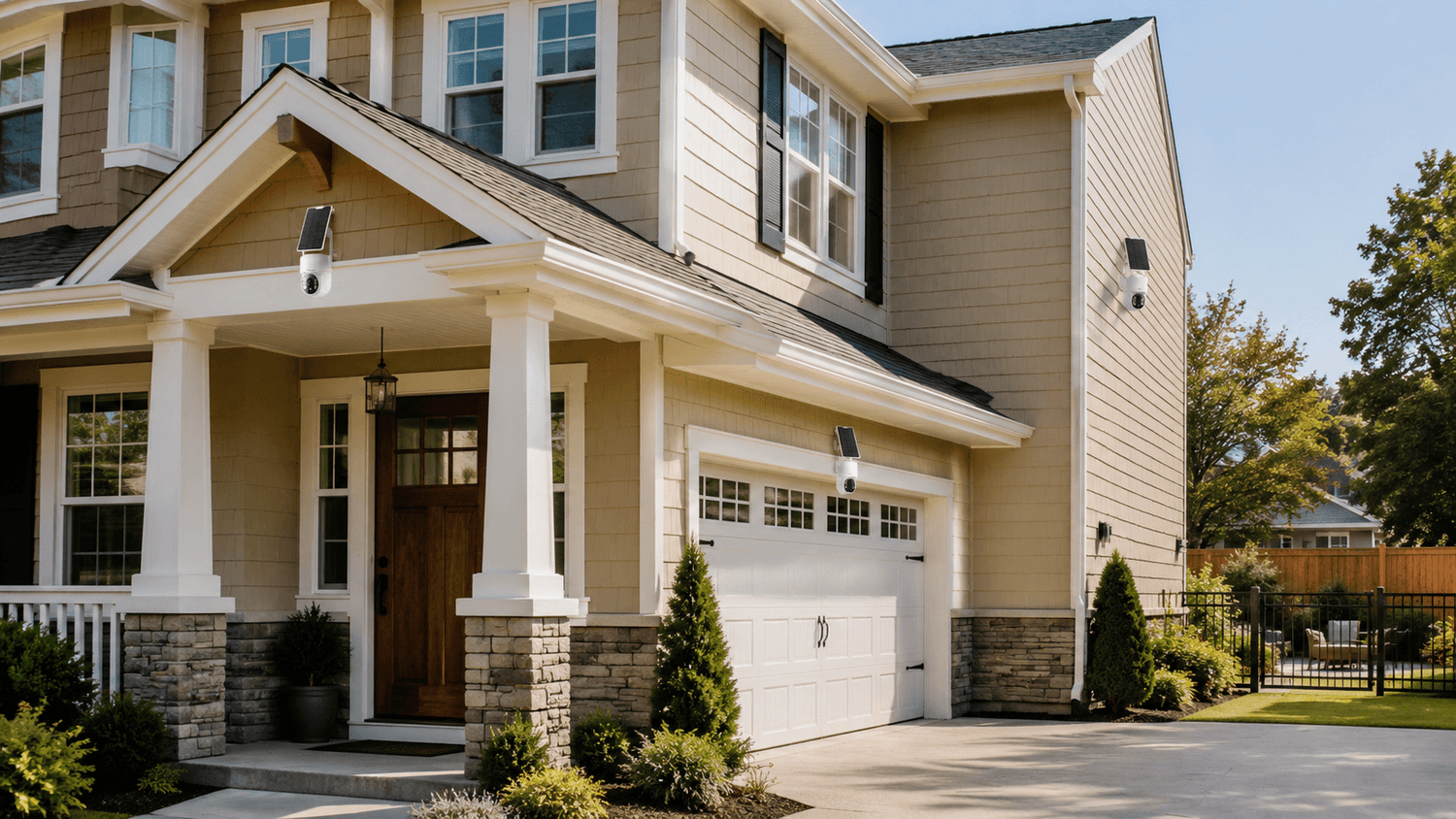
Choosing the best wireless home security camera system in 2026 is no longer simply about finding a camera with the highest resolution.
Modern homeowners want a security system that is easy to install, reliable outdoors, provides clear video day and night, offers local or remote access, and does not create unnecessary monthly costs.
That is why wireless security camera systems have become increasingly popular for homes, garages, driveways, backyards, farms, vacation properties, and small businesses.
But wireless security cameras come in many different configurations. Some use WiFi, some use dedicated wireless connections between cameras and an NVR, while others use solar power or rechargeable batteries. Storage can be handled through an SD card, an NVR hard drive, cloud storage, or a combination of these options.
So, what is the best wireless home security camera system in 2026?
The answer depends on your property and priorities. In this guide, we will explain the most important features to consider and show you how to choose the right wireless outdoor security camera system for your home.
What Is a Wireless Home Security Camera System?
A wireless home security camera system is a surveillance system designed to reduce or eliminate the need for traditional video cables between outdoor cameras and recording equipment.
Depending on the system, cameras may use wireless communication to connect with an NVR, monitor, mobile application, or home network.
A typical wireless security camera system can include:
- Wireless outdoor security cameras
- An NVR or base station
- A monitor or mobile app
- Local or cloud storage
- Motion detection
- Night vision
- Two-way audio
- Rechargeable batteries or solar panels
The biggest advantage is flexibility.
Instead of running long video cables through walls, ceilings, garages, and outdoor areas, homeowners can install cameras in locations that are more difficult to wire.
This makes a wireless security camera system for home particularly useful for driveways, backyards, detached garages, side entrances, farms, and larger properties.

Why Choose a Wireless Security Camera System in 2026?
There are several reasons homeowners are moving toward wireless surveillance systems.
Easier Installation
Wireless cameras can significantly simplify installation because you do not need to run traditional video cables from every camera back to a central recorder.
Flexible Camera Placement
You can position cameras where you actually need coverage instead of choosing locations based on existing cable routes.
Easier Expansion
Many modern wireless NVR systems support additional cameras, allowing you to expand coverage later.
Remote Monitoring
Depending on the system, you can view live video, receive motion alerts, and review recordings through a mobile app.
Solar Power Options
For outdoor cameras, solar power can reduce the need for frequent battery charging or wired electrical connections.
For homeowners looking for a wireless solar security camera system, this can be especially useful around areas where installing power cables is inconvenient.
7 Things to Look for in the Best Wireless Home Security Camera System
Not every wireless security camera system is the same. Before buying, consider these seven factors.
1. Video Resolution
Video quality is one of the first specifications shoppers notice.
A 1080p camera may be sufficient for basic monitoring, but higher-resolution cameras can provide more detail when viewing faces, vehicles, packages, or activity around your property.
For a modern outdoor security camera system, 2K or 2.5K resolution is a good starting point.
Some systems also offer 4MP or 4K cameras for users who want even more detail.
However, resolution is not everything.
Lens quality, image processing, lighting, field of view, and night vision performance all affect the final image.
A well-designed 2.5K security camera can provide a better real-world image than a poorly designed camera with a larger number printed on the box.
2. Night Vision
A home security camera needs to work after sunset—not just during the day.
Traditional infrared night vision produces black-and-white footage, while newer systems can provide color night vision using image sensors and built-in illumination.
Color night vision can make it easier to distinguish details such as clothing, vehicles, landscaping, and other objects in low-light environments.
When comparing the best outdoor security cameras, look for:
- Infrared night vision
- Color night vision
- Low-light performance
- Night detection range
- Automatic day/night switching
For homes with driveways, backyards, or side entrances, night performance can be just as important as daytime resolution.
3. Wireless Connectivity
“Wireless” does not always mean the same thing.
Some cameras connect directly to your home WiFi network. Others communicate with a dedicated NVR or base station.
WiFi security cameras can be convenient for smaller installations, especially when the cameras are within reliable WiFi coverage.
For larger properties, however, a dedicated wireless NVR system can provide a more centralized solution.
Before purchasing, consider:
How far is each camera from the NVR or router?
Walls, floors, trees, buildings, and other obstacles can affect wireless communication.
For larger properties, choosing a system designed around a dedicated NVR can simplify management and provide a central location for recordings.
4. Local Storage vs Cloud Storage
Storage is one of the most important decisions when choosing a wireless security camera system.
Cloud storage is convenient because footage can be stored remotely. However, some cloud services require monthly or annual subscription fees.
Local storage works differently.
An NVR can record video directly to a hard drive, allowing homeowners to maintain their recordings locally.
For example, the Camcamp SC43 includes a 500GB hard drive and a 10.1-inch NVR monitor. The system is designed to support local playback without requiring an internet connection for its basic local monitoring and recording functions.
This can be particularly attractive to homeowners who want a security camera system with no monthly fee.
Local storage also gives homeowners greater direct control over their recordings.
5. Solar Power and Battery Life
Power is another major consideration for outdoor security cameras.
A wired camera requires a nearby power source and cable.
A battery-powered wireless camera is easier to install, but you eventually need to recharge or replace the battery.
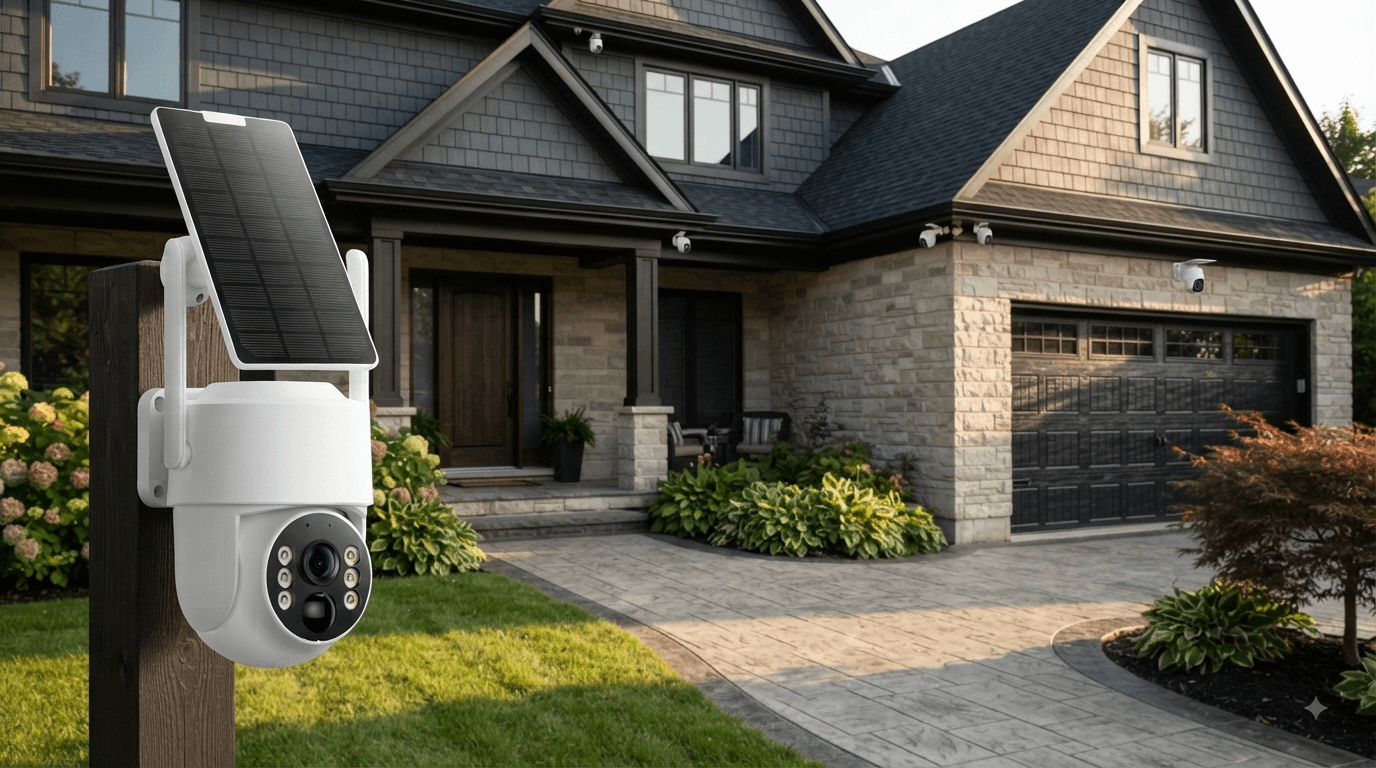
A solar-powered security camera combines a rechargeable battery with a solar panel.
During daylight hours, the panel can replenish the camera's battery, helping reduce maintenance.
Solar security cameras are particularly useful for:
- Driveways
- Backyards
- Gardens
- Farms
- Detached garages
- Gates
- Vacation homes
- Remote outdoor areas
However, solar performance depends on factors such as sunlight, weather, panel placement, and camera activity.
If you choose a solar security camera, install the panel where it can receive adequate daylight.

6. Motion Detection and Smart Alerts
A good security camera should not simply record everything.
Modern systems can use motion detection to identify activity and trigger recordings or alerts.
Depending on the model, motion detection can help monitor:
- People
- Vehicles
- Animals
- Packages
- Unexpected movement
Customizable detection areas can also help reduce unnecessary alerts from roads, trees, or other areas that you do not need to monitor.
For example, you may want a camera watching your driveway but not receiving alerts every time a vehicle passes on the street.
Smart motion detection is therefore an important feature when comparing wireless outdoor security cameras.
7. Field of View, PTZ and Camera Coverage
Installing more cameras is not always the best answer.
The camera's field of view matters.
A wide-angle camera can cover a larger area, while a PTZ camera can physically change its viewing direction.
For larger properties, PTZ functionality can be particularly useful for monitoring driveways, yards, entrances, and open outdoor spaces.
Some systems also allow multiple cameras to work together through a single NVR.
The goal is not simply to install as many cameras as possible.
The goal is to eliminate important blind spots.
Best Wireless Home Security Camera System for Most Homes
If you want an all-in-one system that combines wireless installation, solar power, local recording, and a dedicated monitor, the Camcamp SC43 is one of the strongest options in the current Camcamp lineup.
The SC43 is a 100% wireless solar-powered security camera system with 4MP/2.5K cameras, a 10-channel NVR, a 10.1-inch monitor, 500GB hard drive, color night vision, motion detection, two-way audio, and remote app access. The system can be expanded to up to 10 cameras.
Camcamp SC43 Wireless Solar Security Camera System
One of its biggest advantages is that it combines several features that homeowners normally have to purchase separately.
You get:
Wireless cameras + solar power + NVR + monitor + local storage + remote app access
That makes it particularly suitable for homeowners who want a complete system rather than a collection of individual cameras.

Camcamp SC43 vs a Typical WiFi Security Camera
A single WiFi security camera can be an excellent choice for a front door or small apartment.
But a complete wireless NVR system makes more sense when you need coverage across multiple areas.
| Feature | Single WiFi Camera | Wireless NVR System |
|---|---|---|
| Multiple cameras | Limited | Excellent |
| Local recording | Depends on model | Yes |
| Centralized monitoring | Limited | Yes |
| Large property coverage | Limited | Better |
| Dedicated monitor | Usually no | Yes |
| Expandability | Varies | Often available |
| Solar options | Available | Available |
| Best for | Single areas | Whole-property monitoring |
If you only need to watch your front door, a single smart camera may be enough.
If you want to monitor your front door, driveway, backyard, garage, and side entrance, a wireless NVR system is usually a better approach.
Where Should You Install Wireless Outdoor Security Cameras?
The best security camera system can still perform poorly if the cameras are installed in the wrong locations.
For most homes, start with these areas:
Front Door
Monitor visitors, deliveries, and activity around the main entrance.
Driveway
A driveway camera can help monitor vehicles and movement approaching your property.
Backyard
Backyards can be vulnerable because they are often less visible from inside the house.
Garage
A garage camera can monitor vehicles, tools, equipment, and entry points.
Side Entrance
Side gates and side doors are common areas where visibility can be limited.
For larger properties, consider adding cameras to gates, workshops, barns, sheds, or other important structures.

Wireless vs Wired Security Cameras: Which Is Better?
Neither technology is automatically better.
A wired security camera system can offer excellent reliability and is ideal for permanent installations where running cables is practical.
Wireless systems offer easier installation and greater flexibility.
| Feature | Wireless System | Wired System |
| Installation | Easier | More complex |
| Cable requirements | Minimal | More extensive |
| Camera placement | Flexible | Limited by wiring |
| DIY installation | Often easier | May require more work |
| Expansion | Convenient | More installation work |
| Best for | Existing homes & flexible layouts | Permanent installations |
For homeowners who want a DIY-friendly solution without running multiple cables through their property, wireless security cameras are an attractive option.
Do Wireless Security Cameras Need WiFi?
Not necessarily.
This is an important distinction.
Some wireless security cameras require WiFi to communicate with the internet or mobile application.
However, some wireless NVR systems use a dedicated wireless connection between the cameras and the NVR.
For example, the Camcamp SC43 is designed so that local monitoring and recording do not require an internet connection. Remote app access does require an internet connection.
This means you should always check what “wireless” means for a specific security camera system before purchasing.
Are Wireless Security Camera Systems Worth It in 2026?
For many homeowners, yes.
The combination of easier installation, high-resolution video, motion alerts, local storage, mobile monitoring, and solar power makes modern wireless security systems considerably more capable than older wireless cameras.
The best system is not necessarily the one with the most features.
It is the one that fits your property.
If you live in a small apartment, a single WiFi camera may be enough.
If you own a suburban home with a driveway and backyard, a multi-camera wireless system may be more appropriate.
If you have a large property, farm, or detached buildings, consider a system that supports multiple cameras, local recording, and solar power.
Final Verdict: What Is the Best Wireless Home Security Camera System in 2026?
When choosing the best wireless home security camera system in 2026, focus on the entire system rather than one specification.
Look for:
- 2K or higher video resolution
- Reliable wireless connectivity
- Strong night vision
- Motion detection
- Local storage
- Remote monitoring
- Solar or battery power for outdoor cameras
- Weather-resistant construction
- Two-way audio
- Expandable camera capacity
For homeowners who want a complete outdoor surveillance solution, a wireless solar security camera system with an NVR offers an excellent combination of convenience, coverage, and long-term value.
The Camcamp SC43 is particularly well suited to this use case because it combines solar power, wireless cameras, a 10-channel NVR, a dedicated 10.1-inch monitor, 500GB local storage, color night vision, motion detection, and two-way audio in one system.
Ultimately, the best home security camera system is the one that protects the areas that matter most without making installation and maintenance unnecessarily complicated.
For many homeowners in 2026, wireless + solar + local NVR storage is one of the most practical combinations for whole-property security.

Leave a comment
This site is protected by hCaptcha and the hCaptcha Privacy Policy and Terms of Service apply.